Overview and Background
In 2025, 29.9 million internal disaster displacements were recorded globally, with approximately 13.6 million individuals remaining displaced at year-end. In the Americas, more than 4.3 million displacements were registered in 2025—over 52 per cent of which represented life-saving preventive evacuations, notably in Chile and Cuba. However, roughly 360,000 individuals remained displaced across the region at the close of 2025, primarily in Jamaica following Hurricane Melissa.
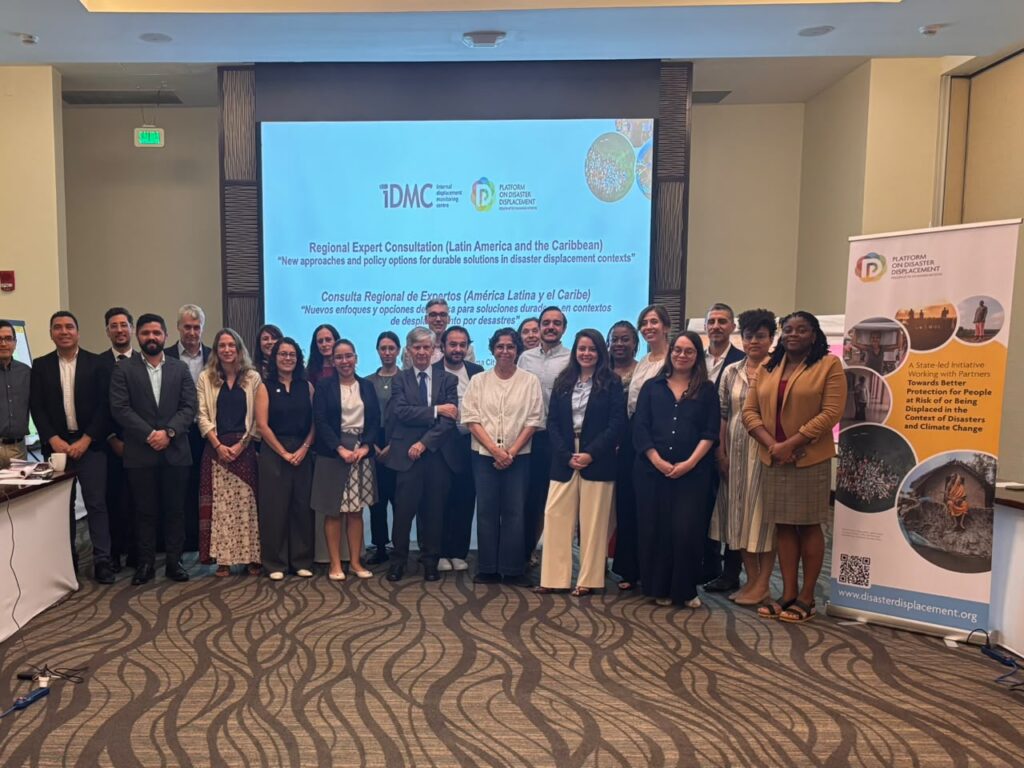
The Panama Consultation convened government officials, regional institutions, legal scholars, and operational practitioners to examine why disaster displacement frequently becomes protracted. Grounded in two foundational studies—the draft Policy Paper From Crisis Management to Climate Resilient Development Solutions and the PDD–IDMC Global Study on Protracted Disaster Displacement—the report identifies actionable pathways to transition from short-term relief toward rights-based, government-led, and development-oriented durable solutions.
Key Findings and policy options
-
Drivers of Protracted Displacement Beyond Hazard Severity: Physical hazard impact initiates displacement, but duration is driven by structural factors: insecure land tenure, loss of productive livelihoods, fragmented public services, and recurrent risk. Case evidence from Dominica (Petite Savanne relocation) and southern Brazil highlights that physical shelter provision alone cannot resolve displacement without secure tenure, economic recovery, and basic infrastructure.
-
Recovery as Reconstruction of “Life Projects: Recovery frameworks must extend beyond replacing physical dwellings to address psychosocial well-being, cultural identity, social cohesion, and territorial ties, especially for Indigenous peoples and traditional communities.
-
Solutions from the Start” in Humanitarian Action: Early emergency decisions directly influence long-term outcomes. Risk reduction, anticipatory action, and early recovery must operate concurrently with emergency response, strengthening local systems and providing civil documentation to avert parallel administrative structures.
-
Whole-of-Government Coordination & Local Devolution: Fragmented mandates across civil defense, housing, environment, and social protection delay recovery. National governments must anchor displacement within development plans and public budgets, while devolving statutory powers and financing to municipalities.
-
Legal Frameworks & Institutional Enablers: Regional advancements—such as Colombia’s Constitutional Court Judgment T-123/2024, its national disaster displacement registry, and Panama’s National Protocol on Planned Relocation—demonstrate the value of statutory recognition backed by inter-agency coordination and access to justice.
-
Diversified Financing Instruments: Achieving durable solutions requires moving beyond traditional humanitarian budgets to engage multilateral development banks, national public budgets, climate adaptation funds, Loss and Damage mechanisms, and contingency credit lines.
With The Generous Support Of:
Federal Ministry for Economic Cooperation and Development (BMZ) | Deutsche Gesellschaft für Internationale Zusammenarbeit (GIZ) | European Union (EU) | Swiss Agency for Development and Cooperation (SDC)


 Reload document
 Open in new tab