Reporting Back – Virtual Dialogues on Challenges and Prospects for Planned Relocation
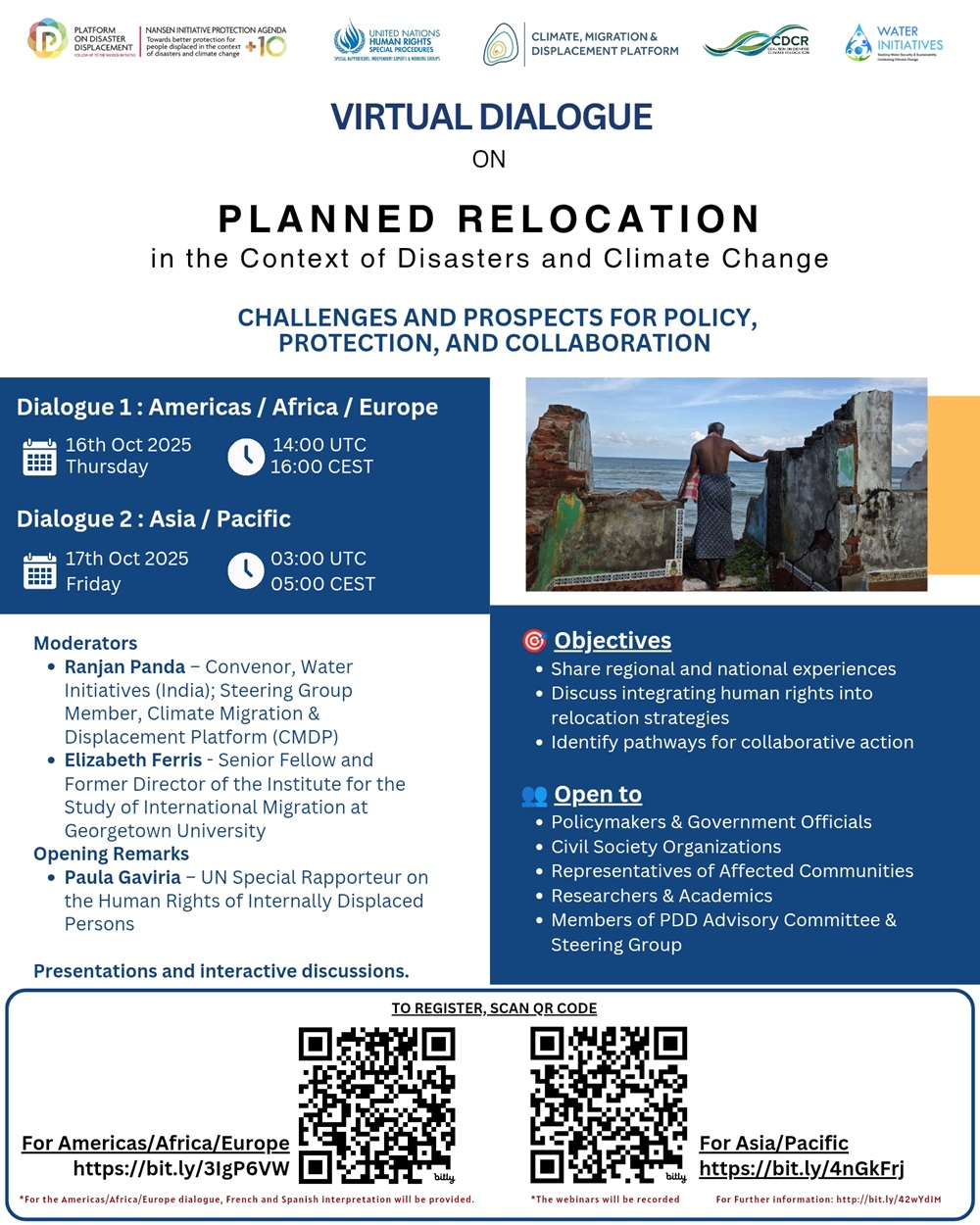
Online, 16-17 October 2025 – The Platform on Disaster Displacement (PDD), Water Initiatives, the Climate, Migration and Displacement Platform (CMDP), the Coalition on Dignified Climate Relocation (CDCR) and the Special Rapporteur on the Human Rights of Internally Displaced Persons are co-organizing virtual dialogues on challenges and prospects for planned relocation in the context of disasters and adverse effects of climate change on 16-17 October 2025. The session for Europe, the Americas and Africa will take place on 16 October 2025, 16:00 CET, participants can register here. The session for Asia Pacific will take place on 17 October 2025, 05:00 CET, participants can register here.
Participation and Scope of the Virtual Dialogues
Over 100 stakeholders joined the calls, including government officials, civil society organizations, academics, as well as PDD Advisory Committee members, members of the Coalition for Dignified Climate Relocation and of the Climate, Migration and Displacement Platform. Participants contributed their perspectives, shared their experiences and identified effective practices on planned relocation, including regarding: i) the development of policies, laws or strategies, ii) funding mechanisms, iii) approaches for consultation and inclusion of communities in all stages of planned relocation processes, iv) practical operational strategies to minimize loss and damage and protect human rights.
Key Contributions from Partners
The Special Rapporteur on the human rights of IDPs, Paula Gaviria Betancur, highlighted the key messages from her June 2024 report to the Human Rights Council which she had drafted based on contributions from stakeholders in different regions. She stressed that planned relocation must remain a measure of last resort, that planned relocation should only be considered in exceptional circumstances when other forms of adaptation are no longer possible, and that meaningful, effective participation of communities is essential to the success of any planned relocation. She noted that unfortunately to date, participation is too often inadequate or tokenistic. Planned relocations are complex and can entail serious human rights risks if not undertaken and supported properly. She demanded that planned relocation must enable a path towards durable solutions and affected persons should be at the center of all relevant decision-making.
PDD Regional Advisers Juan Carlos Mendez Barquero and Naca Bolo briefed on recent engagement in the Americas and Pacific regions, inter alia providing the governments of Colombia and Panama with support for the development of planned relocation policies and guidance; and supporting the governments of Fiji and Bangladesh in a peer to peer exchange of effective practices on planned relocation. Both regions are seeing the development of regional guidance on human rights respecting planned relocation.
The virtual dialogues were also a moment to present the Coalition for Dignified Climate Relocation that was launched in June 2025, where over 40 relocating community leaders and their supporters gathered in NYC. The Coalition’s mission is to advance more dignified, rights-respecting, and community-centered approaches to this unique form of human mobility related to the climate crisis. One of the coalition’s goals is to advocate for countries to develop and adopt rights-respecting national planned relocation policies or governance frameworks.
The virtual dialogues presented an opportunity to launch the report “Funding Futures – Access to Funding for Planned Relocation as Loss and Damage”, jointly created by the PDD Secretariat and the United Nations University Institute for Environment and Human Security (UNU-EHS). The report provides insights regarding available evidence of the funding of planned relocation processes in the context of disasters and climate change, looking at funding sources, mechanisms, recipients, and allocation of financial resources for 34 selected planned relocation cases.
The virtual dialogue was also an opportunity to present ongoing use and updates to the 2021 study Leaving Place Restoring Home that was co-commissioned by the PDD and the Andrew & Renata Kaldor Centre for International Refugee Law at UNSW Sydney. Researchers who are interested to contribute to updating certain aspects, are invited to contact the PDD Secretariat.
The PDD has also supported UNU-EHS and the Centre for Systems Solutions with the design of a Planned Relocation Simulation/serious game. For more information, contact UNU-EHS or look at this website.
Highlights from the Americas
The webinar taking place for the Americas, Europe, and Africa time zone was moderated by Beth Ferris, from Georgetown University, and opened with welcome remarks from Zenaida Lauda-Rodriguez representing RESAMA, highlighting important advances in the work on disaster displacement in the context of climate change in the region. She stressed the need for a paradigm change from reacting to climate displacement to a more anticipatory, preventative approach.
Simon Trichot from the Ministry of Environment of Panama presented the country’s currently ongoing process of developing a national protocol on planned relocation. This protocol will guide different Panamanian authorities involved in the issue and ensure a human rights-based approach to planned relocations. He presented the recent experiences of a community planned relocation in Gardi Sugdub as an effective practice of community engagement and leadership.
Discussion ensued on how to address issues related to risk assessments, ensuring livelihoods, and respecting land attachment and cultural heritage, as well as achieving durable solutions through working with communities and local actors.
The webinar benefited from interpretation into French and Spanish, courtesy of CMDP.
Highlights from the Pacific
The webinar taking place for the Asia and Pacific time zone was moderated by Ranjan Panda, representing Water Initiatives – India, the Climate, Migration and Displacement Platform, and the Coalition.
Nina Sikiti, from the Planned Relocation Unit, Ministry of Maritime and Rural Development and Disaster Management of Fiji shared Fiji’s experiences developing its Planned Relocation Strategy and SOP, in line with relevant climate change and DRR policies, as well as relevant funding mechanisms. She emphasized the whole-of-government and whole-of-society approach and highlighted the importance of considering cultural heritage throughout the process.
Perspectives that emerged in the discussion were intergenerational and youth considerations, approaches to restorative justice, and learning from relocation processes undertaken in the context of drivers other than disasters and climate change, such as development and conflict.
Background and Context of the Virtual Dialogues
The virtual dialogues were organized in the context of commemorating the ten years since the endorsement of the Nansen Initiative Protection Agenda by over 100 governmental delegations in October 2015. Planned relocation emerged as one of the key areas relevant to advancing the protection of persons displaced in the context of disasters and climate change and has been figuring in the PDD’s strategies and workplans since 2016.
2025 also marks the ten-year anniversary of the publication of the “Guidance on Planned Relocation” by Brookings, UNHCR and Georgetown University in 2015.
The virtual dialogues followed up on an online meeting on planned relocation in the context of disasters and climate change that was organized in October 2024 and at which an Information Brief was presented. They also followed up on the online meetings that the United Nations Special Rapporteur on the human rights of internally displaced persons, the Secretariat of the PDD and regional partner networks organized in March 2024, with a view to collecting input to the Special Rapporteur’s report to the Human Rights Council in June 2024.
Key Points Emerging from the Virtual Dialogues
Planned relocation is a measure of last resort. In some places, adaptation limits are now reached and entire communities have no choice but to move permanently out of harm’s way and into areas with lower exposure to disaster risks and climate impacts.
Planned relocation is recognized in policy and practice as a tool for disaster risk reduction and climate change adaptation. At the same time, it is also a cause and consequence of loss and damage.
If not well planned, resourced and conducted with community involvement and leadership, the process risks negatively impacting economic and non-economic aspects of people’s lives and threatening their human rights. If planned relocations are carried out, they must be voluntary, community-driven, planned and rights-based processes.
Countries need to step up and develop policies, strategies, laws, funding mechanisms and tools, and assign institutional responsibility to support planned relocation processes and to ensure that human rights principles guide all action on planned relocation.
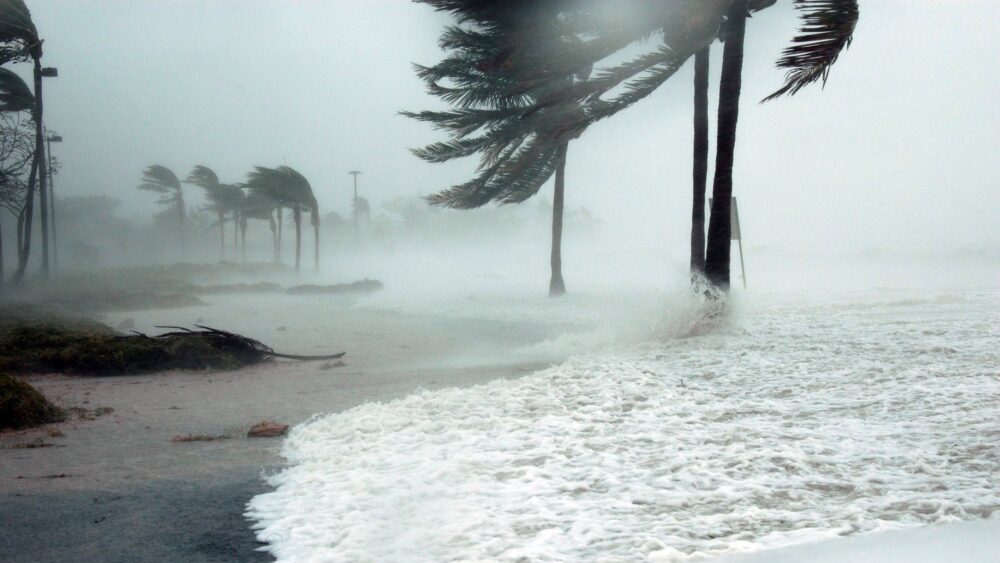
Cover photo: free public domain CC0 photo