Geneva Technical Briefing: Advancing the Treaty on the Protection of Persons in the Event of Disasters
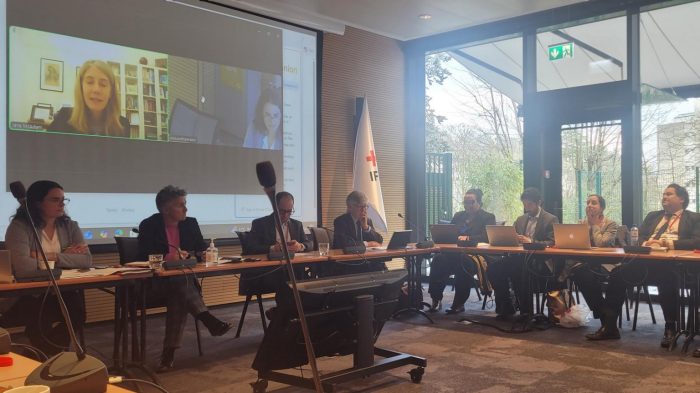
23 March 2026, Geneva, Switzerland – The Platform on Disaster Displacement (PDD) and the Kaldor Centre for International Refugee Law, in collaboration with the International Federation of Red Cross and Red Crescent Societies (IFRC), hosted an in-person technical briefing in Geneva. The event brought together representatives of Member States, UN organizations, PDD Advisory Committee Members, and other key stakeholders to discuss the proposed Treaty on the Protection of Persons in the Event of Disasters (PPED Treaty).
Overview and Purpose
In 2024, the UN General Assembly decided to elaborate and conclude a legally binding treaty on this topic by the end of 2027, based on the International Law Commission’s 2016 Draft Articles (A/RES/79/128). Since that decision, States and other stakeholders have engaged in discussions and submitted written proposals to amend the draft text. The process is now entering a pre-negotiation phase ahead of the formal diplomatic conference in early 2027. In this context, the Sixth Committee session scheduled for 6–10 April 2026 in New York, which will consider a revised text, reflecting the proposals submitted, represents an important opportunity to consolidate areas of convergence and identify issues requiring further consideration.
The technical briefing was convened to provide an update on the status of the PPED Treaty process and next steps, and to create space for information-sharing among Geneva-based colleagues and exchange ahead of the UN Sixth Committee Working Group session. It discussed the scope of the PPED Treaty, considerations for protection of persons and international cooperation, and how displacement, and the protection of displaced persons, could feature in the evolving draft text. The technical briefing was opened by the IFRC and the Government of Costa Rica in its capacity as Chair of the PDD and moderated by Professor Walter Kaelin, Envoy of the Chair of the PDD. The panel discussion featured presentations by experts, followed by reflections and interventions from States and the European Union. The Government of Costa Rica, the PDD and the IFRC provided closing remarks.
Summary of Presentations and Exchange
The briefing:
- underscored the importance of the PPED Treaty process as a significant development in the international legal framework governing disasters and the protection of affected persons;
- discussed the relevance of the PPED Treaty for strengthening international cooperation and clarifying responsibilities;
- emphasized the importance of keeping the protection needs of persons affected by disasters, at the centre of the PPED Treaty, and explored how displacement could be more clearly reflected in the evolving text;
- reinforced the value of State engagement both ahead of, and in a more sustained manner following, the April 2026 Sixth Committee Working Group session;
- demonstrated the direct relevance of the PPED Treaty for stakeholders working across policy and practice on the disaster risk management continuum, humanitarian response, protection and displacement;
- underscored the role of Geneva-based stakeholders in helping to ensure that the PPED Treaty is practical, reflects humanitarian considerations and strengthens the capacity of local actors;
- reflected the strong interest among Geneva-based stakeholders in remaining informed and engaged as the PPED Treaty process moves forward.
Caroline Holt, Director of the Disaster, Climate and Crises Department at the IFRC, emphasized that disaster response and displacement are strategic priorities and a daily reality for 191 National Societies and 16 million volunteers. With the IFRC responding to 400+ disasters and assisting 18 million displaced people annually, she highlighted National Societies as local first responders who remain engaged through long-term recovery. She framed the PPED Treaty as an important opportunity to strengthen global solidarity, reinforce disaster risk reduction across the management continuum, and facilitate fast, effective, and coordinated international humanitarian assistance.
Roberto Céspedes Gómez, on behalf of the Government of Costa Rica and as the Chair of the PDD Steering Group, emphasized the urgency of the briefing as disaster impacts rise under global warming, noting 100 million people are affected annually and over 45 million were displaced in 2024. He welcomed the UNGA decision to finalize a binding PPED Treaty by 2027, which will reinforce PDD’s strategic priorities. He framed the briefing as a key Geneva-based exchange ahead of the April 2026 New York session to ensure displacement and the protection of displaced persons are explicitly reflected in the evolving text.
Martina Müller, Programme Manager, Partnerships, UNDRR, New York Liaison Office, noted the PPED Treaty represents a significant advance in international disaster law. She emphasized its potential to enshrine disaster risk reduction more firmly than the non-binding Sendai Framework, strengthening long-term accountability and reinforcing existing commitments. Highlighting substantial Member State engagement, she noted that as of March 2026, 28 submissions and the compilation document (A/80/610) provide the foundation for the next stage of consideration by the Sixth Committee Working Group.
Isabelle Granger, Global Lead, Disaster Law and Auxiliary Role at the IFRC, Isabelle Granger, IFRC Global Lead for Disaster Law and Auxiliary Role, emphasized that the PPED Treaty offers a vital opportunity to strengthen international law by centring the protection of persons, including displaced persons, across the disaster risk management continuum. She highlighted three IFRC priorities: stronger protection and humanitarian assistance language; binding disaster risk reduction obligations to mitigate displacement risks; and clearer facilitation measures for external assistance to ensure well-coordinated action. Strengthening the treaty in these areas would improve protection for vulnerable populations, reinforce domestic leadership, and help save lives in disaster contexts.
Prof. Jane McAdam, Director of the UNSW Kaldor Centre’s Evacuations Research Hub, emphasized that displacement is a central consequence of disasters and must be explicitly reflected in the PPED Treaty. She noted that while disasters drive large-scale displacement, the current draft only refers to it indirectly; express acknowledgment is key to ensuring risk reduction, response, and recovery are designed with displaced people’s lived experiences in mind. Drawing on evolving State practice, she proposed that the Treaty recognize evacuations and planned relocations as risk reduction measures, while including evacuation support and humanitarian visas as forms of international cooperation. Such inclusion would provide an essential interpretative framing and “hook” for future action, strengthening protection across national law, financing, and diplomacy.
Conclusion
Several States and the European Union welcomed the briefing, reiterating their commitment to negotiate the new treaty. Participants stressed the importance of anchoring the treaty in the principles of the UN Charter, national sovereignty, and human rights standards. Prof. Walter Kaelin closed the session by reinforcing the importance of the treaty as a framework for strengthening international cooperation and ensuring practical and humanitarian considerations are reflected in the final text.