June 2025, New York City, United States – New Global Coalition Advances Rights-Based Climate-Related Planned Relocation
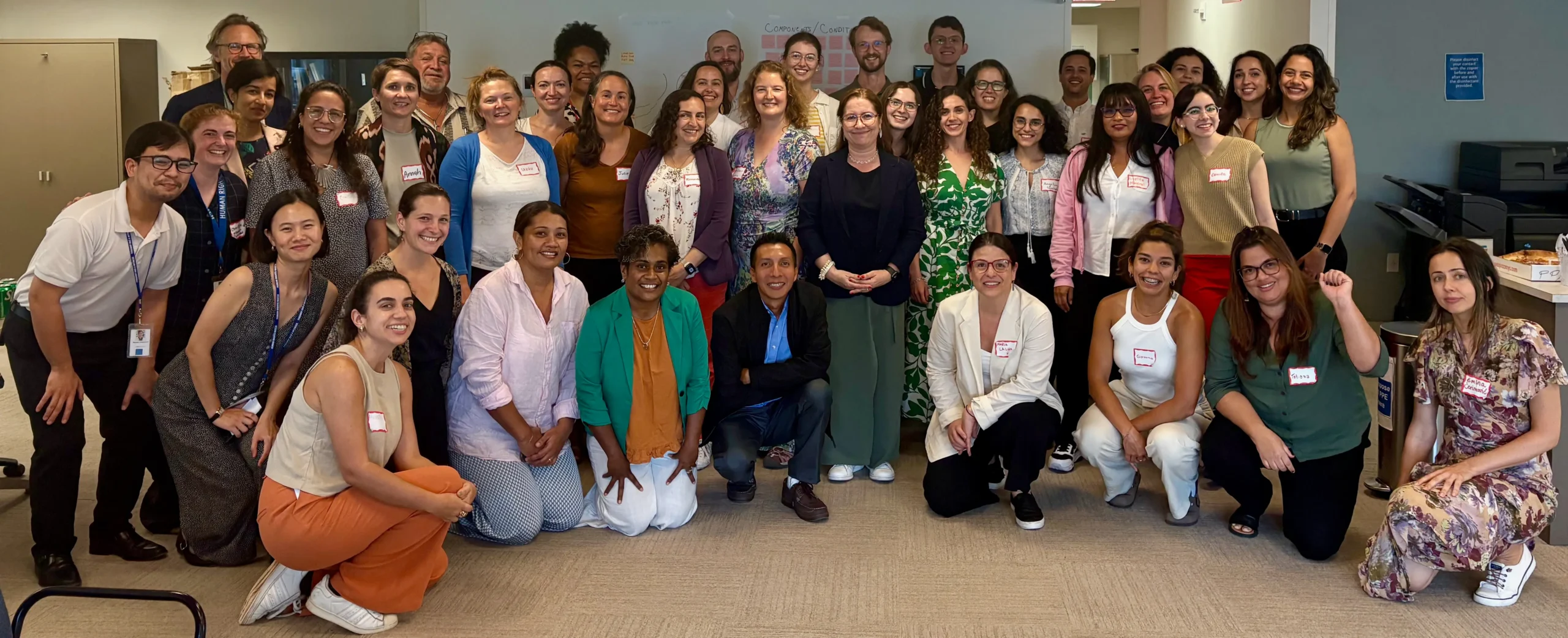
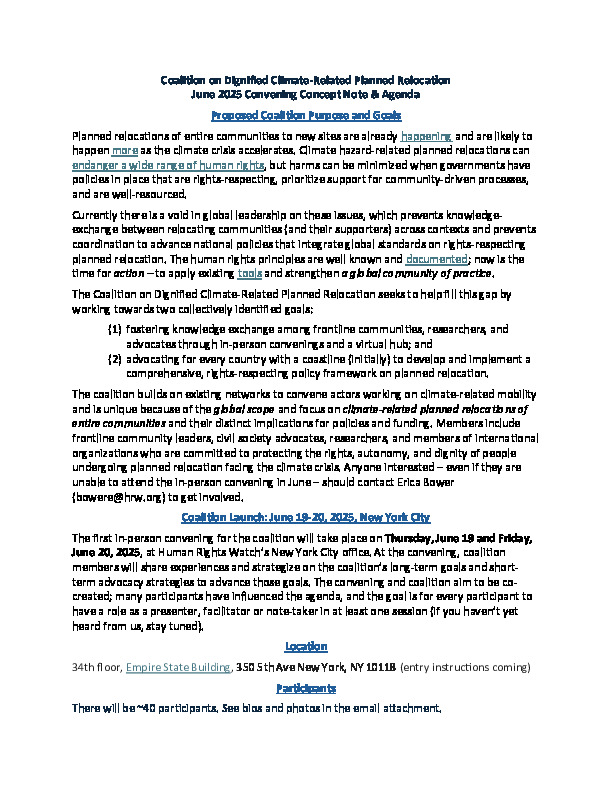
More than 40 community leaders, advocates, and researchers from across the globe convened in New York City on 19–20 June 2025 for the launch of the Coalition on Dignified Climate-related Planned Relocation. The convening was hosted in the Human Rights Watch New York Office, with generous support from the Robert Bosch Stiftung, and contributions from the PDD and its Advisory Committee members. It marked the beginning of a new global alliance dedicated to ensuring that communities facing climate-related planned relocation can do so on their own terms, with dignity and full respect for human rights.
As climate impacts accelerate, planned relocation is increasingly becoming a reality, particularly for communities in coastal and climate-vulnerable regions and often in the absence of adequate government support. While relocation is widely recognized as a measure of last resort, participants emphasized that it is already occurring across diverse contexts, frequently without clear legal frameworks, sufficient resources, or meaningful community leadership. The Coalition was formed to respond to this growing gap between principles and practice.
Centering communities most affected by climate change
Discussions throughout the convening were grounded in the lived experiences of communities navigating planned relocation across different political, legal, and cultural contexts. Community leaders from Gardi Sugdub in Panama, El Bosque in Mexico, Enseada de Baleia in Brazil, and Isle de Jean Charles in the United States shared their experiences and identified challenges and lessons learned. Despite the very different contexts, participants highlighted strikingly similar challenges: delayed or absent government action, weak legal protections, chronic underfunding, and relocation processes that undermine community autonomy.
Participants stressed that planned relocation can threaten a wide range of rights, including rights to housing, land, livelihoods, culture, and an adequate standard of living, when governments do not make explicit efforts to safeguard these rights. Mental health impacts, cultural loss, and the erosion of traditional governance systems were consistently identified as critical yet under-addressed consequences of planned relocation.
At the same time, the convening underscored the strength and leadership of affected communities. Community organizing, peer-to-peer learning, and strategic partnerships can enable communities to assert their rights, hold governments accountable, and shape planned relocation processes in line with their own priorities. A central message resonated throughout the discussions: communities most affected by climate change must lead the way in decisions about whether, when, and how relocation occurs.
From human rights principles to practice
Participants underscored that climate-related planned relocation must be firmly grounded in international human rights law, with self-determination, free, prior and informed consent, and the protection of land, culture, and livelihoods at its core. While guidance and tools already exist, participants stressed that they are too often inaccessible to communities and inconsistently applied by governments. As the UN Special Rapporteur on the Human Rights of Internally Displaced Persons, Paula Gaviria Betancur, noted, “Planned relocation in the context of climate change must never be reduced to moving people out of harm’s way; it is a rights-based process that requires clear legal frameworks, sustained financing, and the meaningful participation of affected communities at every stage.”
National governance: necessary but not sufficient
The convening examined national policy approaches to planned relocation, noting that only a limited number of countries currently have dedicated frameworks. Participants agreed that while national governance is essential, policies alone are insufficient if they are poorly designed or weakly implemented.
One community representative shared: “When our community was forced to consider relocation, there were no national policies or international guidelines we could actually use. Relocation must be a last resort, and it must not take power away from communities. Any framework that matters is one that strengthens community leadership and keeps decisions in the hands of the people most affected.”
There was strong consensus that planned relocation must be framed as a last resort, and that national frameworks should reinforce community leadership. Participants also stressed the need to address the often-overlooked “waiting period” between recognizing the need to relocate and the completion of relocation, when communities frequently face heightened risks to their rights, livelihoods, and safety.
Importantly, participants emphasized that governments should not wait for new policies to act. Existing laws related to housing, land, disaster response, and environmental protection can and should be leveraged to protect communities in the interim.
Participants explored a range of strategies to influence policy and practice, including grassroots advocacy, engagement with planners and technical experts, research and evidence-building, and strategic use of media. Community-to-community exchange emerged as one of the most effective and empowering forms of support. Peer learning was repeatedly identified as trustworthy and impactful practice.
A shared agenda for the coalition
Looking ahead, coalition members coalesced around two overarching goals:
- Shared learning and knowledge exchange among communities, advocates, and experts engaged in planned relocation.
- Advocating for countries to adopt rights-respecting governance frameworks for climate-related planned relocation that center community leadership.
To advance these goals, the Coalition identified two priority workstreams:
Knowledge production, including guidance for researchers, tools to assess relocation outcomes, evidence on the benefits of community-led approaches, and methodologies that avoid harm and respect cultural context.
Knowledge exchange, including an online resource hub, peer-learning fora, targeted policy engagement, and coordinated messaging in international climate and policy processes.
Participants emphasized the importance of sustained in-person convenings, complemented by virtual engagement, to maintain momentum and inclusivity.
From principles to political will
Across all discussions, a clear imperative emerged: tools and principles already exist that can inform rights-respecting planned relocation. What is missing is political will, adequate governance frameworks as well as funding and other (governmental) support to communities leading their own relocation processes. As climate impacts intensify and planned relocation is under consideration for more communities, governments must move from rhetoric to action.
The Coalition on Dignified Climate Relocation aims to help close the gap between policy and practice by ensuring that planned relocation is not merely a response to climate hazards, but an opportunity to advance justice, dignity, and resilience in relocation processes taken as a last resort and led by the affected communities themselves.