Financing Planned Relocation in the Context of Climate Change and Disasters
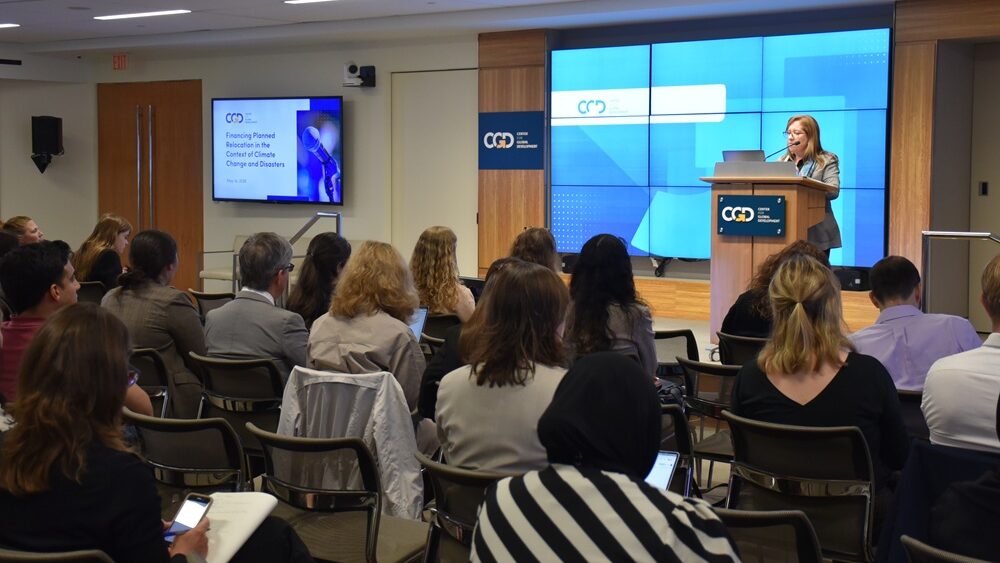
14 May 2026, Washington U.S.A – The Center for Global Development hosted a public event on Financing Planned Relocation in the Context of Climate Change and Disasters in partnership with the Asian Development Bank, the Internal Displacement Monitoring Centre, the Platform on Disaster Displacement and the Coalition on Dignified Climate Relocation. The half-day event brought together global experts and practitioners on planned relocation to assess financing sources and mechanisms, identify remaining policy and research gaps, and discuss challenges, good practices and the role of development finance in advancing planned relocation. This summary highlights the main takeaways from this event.
Vice President and Senior Fellow at the Center for Global Development, Clemence Landers, welcomed the participants and stressed the timeliness of the discussion: evidence abounds that the impacts of climate change increase the risk of displacement, and weather-related disasters continue to force millions of people out of their homes around the world. Planned relocation processes can be an alternative to forced displacement, but are complex and require significant resources. Given the current context of shrinking fiscal space and reduced aid availability, financing from multilateral development banks is likely to become increasingly important.
Paula Gaviria Betancur, UN Special Rapporteur on the human rights of internally displaced persons, shared her experience of engaging with climate-exposed communities around the world, including those forced to leave their homes. She highlighted that planned relocations are not only technically challenging, they are also inherently a human rights issue. If they are carried out in a rights-respecting, dignified manner, planned relocations have the potential to mitigate displacement’s negative consequences and reduce displacement risk, fostering durable solutions for vulnerable communities. The reality however, is that most planned relocation processes occur in an ad hoc manner.
“Planned relocation must always be a measure of last resort. And when they do take place, they must be based on community engagement and human rights,” Paula Gaviria Betancur, UN Special Rapporteur on the human rights of internally displaced persons
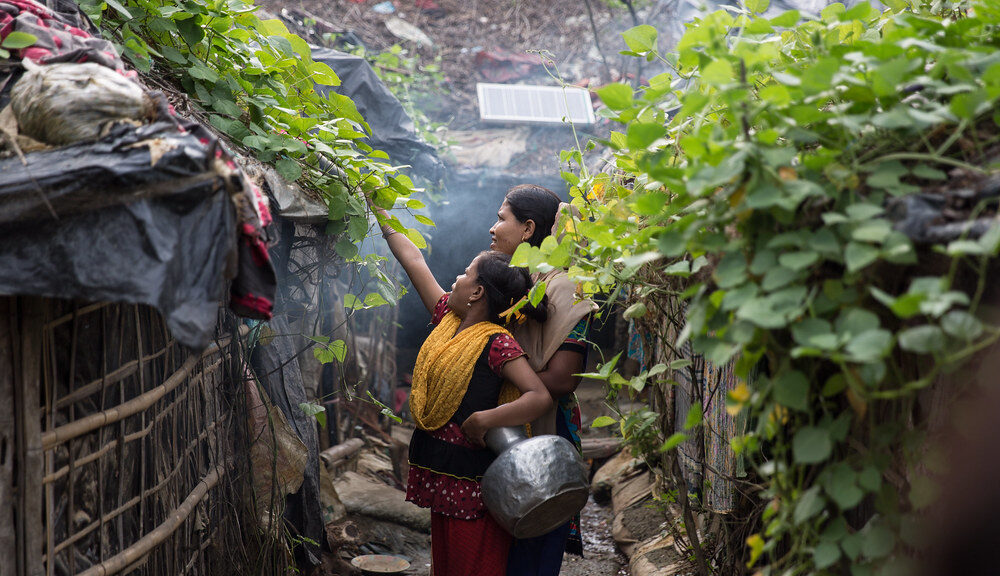
In her visits to communities, the Special Rapporteur witnessed families forced to live for prolonged periods of time in sites that were meant to be temporary, with no means to earn an income and secure sufficient food. Insufficient investments in longer-term solutions left people struggling to secure basic necessities and access health or education, also heightening their vulnerability to abuse or violence. Too often, affected people felt excluded from decisions that directly affected their lives.
Multilateral Development Banks (MDBs) can play a role to ensure that planned relocation processes receive needed resources. They are already trusted partners to governments and can offer loans, grants and technical assistance, encouraging investments in adaptation while ensuring better returns on investments. What is currently missing in planned relocation processes are investments in services, livelihoods, mental health and meaningful participation of affected communities. Affected people are not only rights-holders, but also capable partners. Planned relocation is not only about building houses, but also intangible elements, non-economic assets, trust and human dignity.
Erica Bower, Researcher at Human Rights Watch, and Co-facilitator for the Coalition on Dignified Climate Relocation built on the Special Rapporteur’s intervention to conceptualize what planned relocation contexts can look like in different situations. Typically, people have three adaptation options in the face of coastal climate change impacts like sea level rise: resist (by building higher walls), accommodate (by building stilt houses) or relocate (by planning to move elsewhere collectively) – also called managed retreat or resettlement. International guidance documents have been produced over the past fifteen years to assist governments and communities in planning relocations better. While the exact number of planned relocations that have occurred around the world remains unknown, over 400 cases were documented through a series of research projects by the Platform on Disaster Displacement, the Kaldor Centre and IOM, and will soon be updated with an additional 200 cases. Some of these processes were led by communities themselves, often with little or no support from authorities or external partners.
“Communities request increased support from funders but also direct access to funding so they can make decisions about their adaptation futures for themselves,” Erica Bower, Researcher at Human Rights Watch and Co-facilitator for the Coalition on Dignified Climate Relocation
She shared lessons learnt from planned relocation processes in n diverse contexts, based on extensive interviews with relocating communities. She contrasted the community of Walande, Solomon Islands– where the community relocated largely on their own thanks to remittances, without adequate funding support – with cases in Saint Louis, Senegal and in Gardi Sugdub, Panama, where Multilateral Development Banks (MDBs) provided financial and technical support respectively. All three examples showed the importance of ensuring meaningful leadership and participation from affected communities and their engagement in the process through consultations and informed consent. MDBs may need to adapt their current safeguard policies and funding mechanisms to reflect the specificities of climate-related planned relocation, given that they were not designed with climate change adaptation in mind. She concluded by emphasizing the Coalition on Dignified Climate Relocation’s goals of sharing learning across countries and communities, and jointly advocating for every country with a coastline to develop a national policy framework to protect the rights of relocating communities. More funding is not a silver bullet, but planning ahead and improving policy frameworks – both within governments and MDBs – to address climate-related planned relocation is critical.
Sarah Koeltzow, Co-facilitator of the Coalition on Dignified Climate Relocation then presented key findings from the 2025 study Funding Futures by the Platform on Disaster Displacement and the United Nations University – Institute for Environment and Human Security (UNU-EHS), which analyzed 34 documented planned relocation cases with a specific focus on financing information.
“This presentation on the state of financing for planned relocation in the context of climate change and disasters could be very short: there is very little funding information available to date,” Sarah Koeltzow, Co-facilitator for the Coalition on Dignified Climate Relocation
The data on financing for planned relocation in general is very scarce, as there is a lack of related publications and systematized information. When it is available, it is sometimes difficult to access and interpret. Nonetheless, the study provides a first baseline of the available evidence of financing for planned relocation.
The evidence pointed to planned relocation processes being very lengthy and costly, involving often more than one funding source and mechanism. Communities were sometimes among the recipients of funding, but often did not have a say in the decision-making of how funding was allocated. Relocation processes in higher income countries were often funded from national, sub-national and local government resources. In lower income countries, national governments contributed significantly, often with funds from international partners. Different funding mechanisms, often grants, or in-kind donations (in lower income countries) are used, either simultaneously or one after the other depending on the project phase. They are often not coordinated, potentially leading to inefficiencies. Most of the funding was found to go towards housing construction, with much less allocated to livelihoods and mental health support. 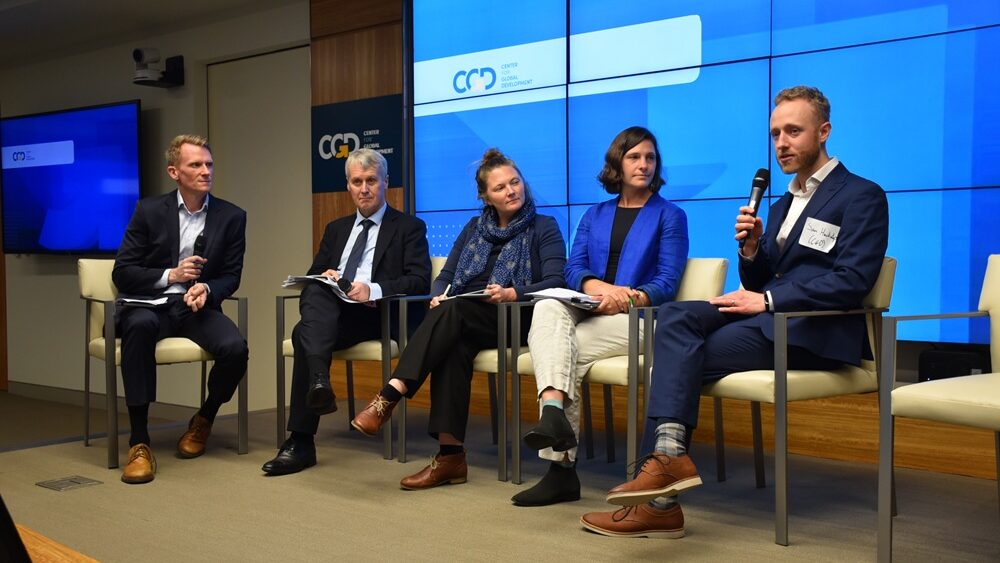
Atle Solberg, Head of the Secretariat of the Platform on Disaster Displacement (PDD) presented the newly released Technical guide on accessing financial resources aiming to avert, minimize and address the impacts of displacement associated with the adverse effects of climate change, which was endorsed by Parties of the United Nations Framework Convention on Climate Change (UNFCCC) under the Executive Committee of the Warsaw International Mechanism for Loss and Damage in September 2025. The technical work to develop this guide was led by the secretariat of the PDD and the International Organization for Migration (IOM).
“The endorsement of this technical guide by Parties represents a milestone in terms of political support for the issue of climate mobility under the framework convention,” Atle Solberg, Head of the Secretariat of the Platform on Disaster Displacement
This practical tool is technical, voluntary and non-prescriptive, responding to the countries’ needs in terms of understanding and accessing finance for human mobility projects and programmes, including displacement, migration and planned relocation. It accompanies governments in identifying what could be an appropriate response to the issue and how to find and access resources for it.
The guide provides an overview of relevant approaches that can help make the case for financing planned relocation through different lenses, such as addressing drivers of displacement, climate adaptation, disaster preparedness, anticipatory action or more. It also provides an overview of different actors, instruments and areas that can be tapped into for funding, including MDBs, development finance institutions (DFIs), bilateral donors, humanitarian funds, climate funds, private banks, philanthropies or insurers. Depending on how the human mobility issue is considered, there is likely to be different financial sources and mechanisms to use.
Thannaletchimy Housset, Global Insights Manager for the Internal Displacement Monitoring Centre, followed-up with a presentation of the latest data available on disaster displacement around the world. The number of internally displaced persons due to disasters significantly increased in 2025 to over 13 million, in large part due to a first-time nationwide assessment led by the International Organization for Migration in Bangladesh, which recorded for 5 million people still living in internal displacement as a result of disasters, a majority of them from disasters that had occurred prior to 2020. While this case is an outlier, it shows that disasters do not only displace people for short periods of time, and many people remain displaced for years or even decades if they do not receive adequate support.
“Disaster displacement is a global phenomenon, recorded across 146 countries and territories in 2025. It can affect anyone, anywhere, any time,” Thannaletchimy Housset, Global Insights Manager for the Internal Displacement Monitoring Centre
In 2025, storms were the main driver of disaster-related displacement with 60% of the total number recorded globally. Wildfires also led to a record number of displacements. Climate change can multiply the risk of displacement linked with disasters, but it is difficult to measure its actual impact. Climate change’s effects are often gradual and not captured by traditional data collection mechanisms and disaster-related assessments.
Although disaster-related displacement differs from planned relocations in many ways, and the Global Report on Internal Displacement does not include specific data on planned relocation, it provides evidence that disasters can lead to displacement and calls for governments and their partners to take preventative measures, including planned relocation where relevant. The Global Report on Internal Displacement also points at data gaps, such as the ones on planned relocations, that should be addressed. Lastly, it reflects on how to accompany people out of their displacement through durable solutions, including returning to their area of origin, integrating in a new environment or rebuilding their lives in a new site where they are relocated.
Sam Huckstep, Research Analyst for the Center for Global Development, closed the round of presentations with a focus on the role of MDBs in financing planned relocation processes. Given financing constraints, loans are likely to be needed for many countries– whether for in-situ adaptation or for planned relocations. The use of loans, however, requires greater fiscal care in planning relocation processes.
“The alternative to relocation, including reconstruction, repairs and assistance to people repeatedly displaced by recurring disasters, is not cost-free,” Sam Huckstep, Research Analyst for the Center for Global Development
 Where in-situ adaptation is unjustifiably expensive, planned relocation can be fiscally prudent and help avoid continuing public losses– which can be important when countries’ limited budgets are needed for competing goods. To assess whether to remain in place or to undertake a planned relocation –and which financing source to use– the use of transparent cost-benefit analysis is crucial. Comparisons must be made between different options, including no action, different in-situ adaptation strategies and planned relocations. Planned relocation also requires consideration of ethical elements, which can be challenging to incorporate in cost-benefit analyses.
In order to result in positive outcomes for relocated communities, key principles must be followed. These include respecting the principle of last resort; ensuring transparency and accountability; maintaining community engagement and consent; minimizing disruption and uncertainty; protecting livelihoods; and limiting non-economic losses and damages. MDBs can offer concessional instruments and capital, but they also have longstanding experience with resettlement processes, lessons from which can inform better investments. Scaling up MDBs’ role in planned relocation would require them to develop a common approach to planned relocation, develop their project preparation and technical capacity building offer, support data provision and offer concessional finance and grants when possible, adapt safeguards, build a related evidence base and develop evaluation standards tailored to planned relocation processes.
To conclude, Steven Goldfinch, Senior Disaster Risk Management Specialist at the Asian Development Bank, led a panel exchange with the audience. The Asian Development Bank has been developing knowledge and conducting research on displacement in the context of disasters and climate change for several years, and more recently is focusing on planned relocation processes and the integration of these considerations into sector investments. Building on the presentations of the day’s speakers, the exchange with the audience contributed many constructive reflections. Questions for discussion included the potential role of remittances and the private sector to supplement funding for planned relocation, and opportunities to scale up planned relocation approaches across different contexts.
Cover photo: trentinness/ Adobe Stock
Event photos: Center for Global Development (CGD)