Regional Expert Consultation on Durable Solutions in Disaster Displacement Contexts
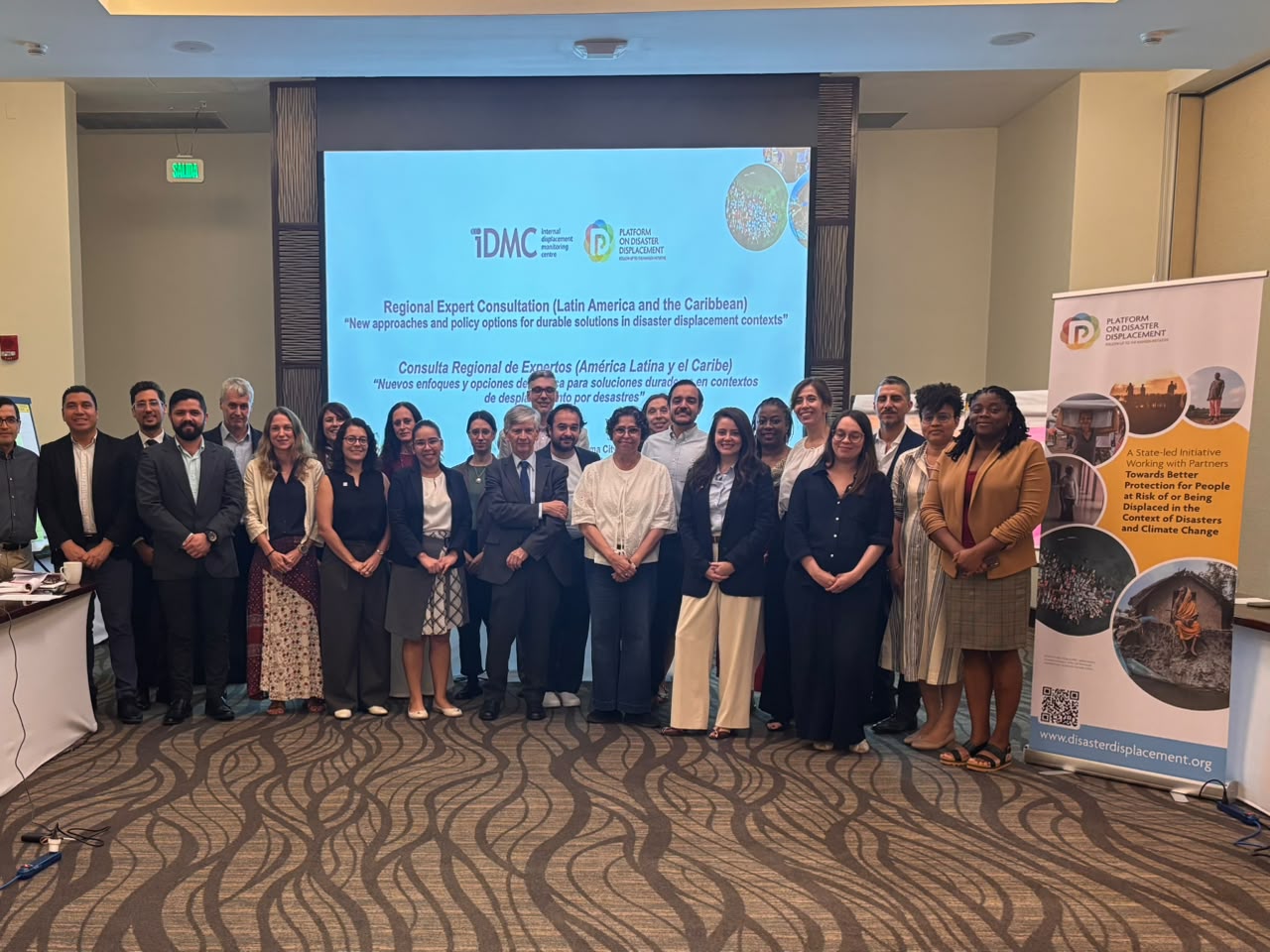
22–23 July 2026, Panama City, Panama – The Platform on Disaster Displacement (PDD) and the Internal Displacement Monitoring Centre (IDMC) co-organized a Regional Expert Consultation on “New Approaches and Policy Options for Durable Solutions in Disaster Displacement Contexts” for Latin America and the Caribbean.
The two-day meeting brought together government officials, disaster risk management authorities, regional climate experts, civil society representatives, academics, and international practitioners. The consultation was convened under the BMZ-funded PDD project on Durable Solutions, supported by Deutsche Gesellschaft für Internationale Zusammenarbeit (GIZ), and IDMC’s EU-funded project under the Directorate-General for International Partnerships (INTPA). Additional support was provided by the European Union Civil Protection and Humanitarian Aid Operations (ECHO) and the Swiss Agency for Development and Cooperation (SDC).
Background and Regional Evidence Base
Disasters and the adverse effects of climate change continue to generate significant internal displacement across Latin America and the Caribbean. Globally, 29.9 million internal disaster displacements were recorded in 2025, with an estimated 13.6 million people remaining displaced at the end of the year. In the Americas, more than 4.3 million disaster displacements occurred in 2025, over 52 percent of which were life-saving preventive evacuations, such as the 1.5 million evacuations conducted in Chile following a tsunami alert.
However, regional data indicates that rapid return cannot be assumed in every situation. Approximately 360,000 people remained in situations of internal disaster displacement across the region at the end of 2025, predominantly in Jamaica following Hurricane Melissa.
Participants reviewed empirical evidence presented by IDMC and examined two complementary draft background documents prepared for the consultation:
Draft Policy Paper: “Disaster and Climate Change Related Internal Displacement: From Crisis Management to Climate Resilient Development Solutions”, authored by Prof. Walter Kälin, Envoy of the Chair of the PDD, establishing a strategic framework to transition from short-term crisis response to government-led, rights-based development solutions.
Draft Global Study: “Protracted Disaster Displacement: A Global Review of the State of Knowledge”, jointly produced by PDD and IDMC, examining the drivers, scale, data gaps, and enabling factors for durable solutions.
The consultation directly aligns with and supports the implementation of the Chile Declaration and Plan of Action 2024–2034 under the Cartagena+40 process, which identifies disaster displacement and climate mobility as priority protection areas in Latin America and the Caribbean.
Why Disaster Displacement Becomes Protracted?
The consultation established that protracted displacement is rarely caused by the triggering hazard alone. Instead, it develops when emergency responses are not connected to timely recovery, or when interventions fail to address underlying structural vulnerabilities.
Expert panel discussions highlighted key drivers that prolong displacement across the region:
- Housing, Land, and Secure Tenure: Renters, informal occupants, and households without formal land titles are frequently excluded from post-disaster reconstruction and compensation schemes.
- Livelihood Destruction and “Life Projects”: Physical housing provision without access to productive land, credit, or employment fails to resolve displacement. Participants emphasized that recovery must restore a community’s broader “life project”—encompassing social cohesion, cultural identity, mental health, and territorial belonging—rather than delivering physical shelter alone.
- Institutional Invisibility: Data collection often ends shortly after the emergency phase, leaving displaced populations and their longer-term protection needs invisible in official statistics and administrative registries.
- Recurrent Risk and Structural Exclusion: Reconstructing housing in unsafe locations reproduces vulnerability. Pre-existing poverty, environmental degradation, and in some contexts generalized violence or conflict further complicate recovery and prevent safe return.
Pathways to Action: Moving from Crisis Management to Development Solutions
Working in thematic groups, participants formulated concrete policy recommendations across four key operational areas:
- Governance and Institutional Arrangements: Mainstream disaster displacement into national development plans, spatial planning, and annual budgeting processes, while establishing permanent coordination mechanisms across disaster risk management, housing, finance, and social protection sectors.
- Government Leadership and Community-Driven Solutions: Guarantee the meaningful, prior, and informed participation of affected communities, Indigenous peoples, and local authorities, ensuring respect for self-determination, cultural adequacy, and access to justice.
- Housing, Livelihoods, and Essential Services: Establish inclusive registration systems with vulnerability indicators for longitudinal monitoring, ensure secure land tenure, adapt housing to local contexts, and support livelihood recovery through skill certification and mixed-use settlement planning.
- Innovative and Diversified Financing: Map and combine national budgets, development assistance, climate adaptation finance, Loss and Damage funding, and private sector investments, while estimating the economic costs of displacement to justify upfront risk reduction.
What Makes a Solution Truly Durable? Regional Practical Experiences
Plenary sessions examined national legislative frameworks, judicial precedents, and practical policy tools for achieving durable solutions:
- Colombia: Presentations reviewed Constitutional Court Judgment T-123/2024, which established human rights obligations across all displacement stages, alongside recent national legislation recognizing internal displacement associated with disasters and climate change and creating a dedicated national registry.
- Panama: The Ministry of Environment presented progress on developing Panama’s National Protocol on Planned Relocation with technical support from PDD, emphasizing the necessity of establishing rights-based, participatory, and culturally appropriate procedures prior to emergencies.
- Dominica: Lessons from the planned relocation of Petite Savanne following Tropical Storm Erika highlighted that physical relocation must preserve social cohesion, economic activities, and community identity alongside housing.
Regional Entry Points and Next Steps
Participants identified key regional policy processes to advance these recommendations over the coming 12 to 24 months:
- Regional Protection & Mobility Frameworks: The Cartagena+40 Chile Plan of Action 2024–2034, the Comprehensive Regional Protection and Solutions Framework (MIRPS), the CARICOM Migration Governance Framework, and OECS free movement arrangements.
- Disaster Risk Reduction & Climate Action: The 2027 Regional Platform for Disaster Risk Reduction in the Bahamas, city networks, and inputs to the IPCC Seventh Assessment Report (AR7).
- Statistical Cooperation: Rolling out the ECLAC/UNHCR/IOM regional practical guide for producing harmonized statistics on forced displacement and migration.
The Panama meeting represents the first of two regional consultations under the project. A second Regional Expert Consultation for Asia and the Pacific will take place in Bangkok, Thailand, in October 2026. The consolidated findings, along with the finalized Global Study and Policy Paper, will be published at the end of 2026 to inform global and regional policy dialogues.
Cover Image: © IOM 2013 (Photo by Joe Lowry)


 Reload document
  Open in new tab